









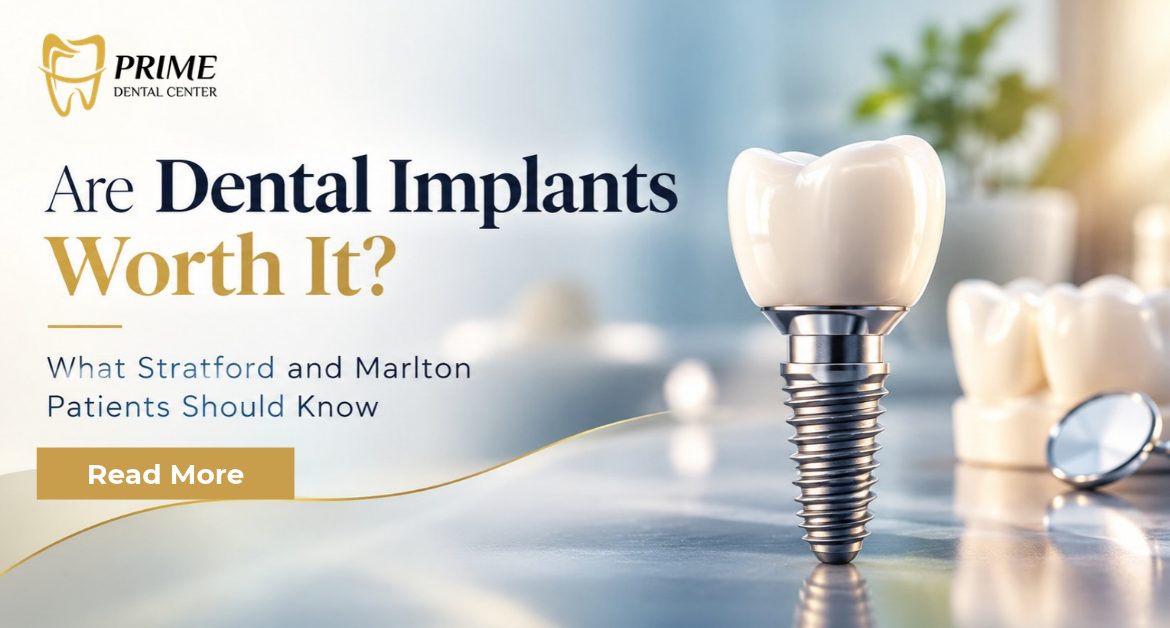
Dental implants are titanium posts surgically placed in the jawbone to replace missing tooth roots, topped with a custom crown that matches your natural teeth. They cost more upfront than bridges or dentures, but they last decades with proper care, preserve jawbone density, and function like natural teeth. At Prime Dental Center in Stratford and Marlton, NJ, Dr. Akshay Rajpal and Dr. Snehal Rajpal evaluate each patient’s bone health and dental history to determine if implants are the right fit.
Missing a tooth changes more than your smile. It changes how you chew, how your jawbone holds its shape, and how the rest of your teeth shift over time. Patients weighing their options often land on the same question: should I get a dental implant, or is a bridge or denture the smarter choice?
The answer depends on your oral health, your budget, and how long you want the solution to last. This guide breaks down what dental implants are, how the procedure works, who makes a good candidate, and what to expect from recovery — so you can walk into your consultation with the right questions already answered.
What is a dental implant, exactly?
A dental implant is a titanium post that replaces a missing tooth root, anchored directly into the jawbone. Once the post fuses with the bone in a process called osseointegration, a dentist attaches an abutment (a small connector piece) and then a custom crown designed to match the color and shape of your surrounding teeth.
This structure mimics the way a natural tooth is built — root, connector, and visible crown — which is why implants function and feel more like real teeth than removable dentures or fixed bridges. Unlike a bridge, which relies on neighboring teeth for support, an implant stands independently. It doesn’t require altering healthy adjacent teeth to hold it in place.
Why do dentists recommend implants over bridges or dentures?
Dental implants preserve jawbone density, while bridges and dentures do not. When a tooth root is missing, the jawbone beneath it gradually loses density because it no longer receives the stimulation that chewing provides. This is a well-documented pattern in restorative dentistry known as bone resorption.
An implant post replaces that missing root and continues to stimulate the bone, which helps prevent the sunken facial appearance that can develop years after tooth loss. Bridges and dentures sit on top of the gum line or attach to nearby teeth, so they don’t address this underlying bone loss.
There are three practical advantages worth naming directly:
Durability: With proper care, implants can last 20 years or longer, while bridges typically need replacement every 10 to 15 years.
Preserved bite function: Implants restore close to full chewing strength, letting patients eat the foods they enjoyed before tooth loss.
No impact on healthy teeth: Bridges require shaving down adjacent teeth for support. Implants don’t touch neighboring teeth at all.
Choose an implant if long-term durability and bone preservation matter more to you than upfront cost. Choose a bridge or partial denture if you need a faster, lower-cost solution and don’t have adequate bone density for an implant post.
What does the dental implant process actually involve?
The dental implant process happens in stages, typically spanning three to nine months from consultation to final crown placement. The timeline varies based on whether bone grafting is needed and how quickly your jaw heals.
1. Get a comprehensive evaluation. Your dentist reviews your dental history, takes X-rays or a 3D scan, and checks whether your jawbone has enough density to support an implant.
2. Complete a bone graft, if needed. Patients with bone loss may need a graft first, adding three to six months of healing time before the implant post can be placed.
3. Have the implant post surgically placed. The titanium post is inserted into the jawbone under local anesthesia, a procedure that typically takes one to two hours per tooth.
4. Allow time for osseointegration. The bone fuses around the post over two to six months, creating a stable foundation for the crown.
Attach the abutment and crown. Once healing is complete, your dentist attaches the connector piece and places a custom-matched crown on top.
Ask your dentist for a written timeline at your consultation, since bone grafting and healing time are the two biggest variables that affect how long the full process takes.
Who is a good candidate for dental implants?
Good candidates for dental implants have healthy gums, adequate jawbone density, and no uncontrolled conditions that impair healing, such as unmanaged diabetes. Age alone isn’t a barrier — patients in their 70s and 80s regularly receive implants successfully, provided their overall oral and bone health supports it.
Smokers and patients with a history of gum disease face a higher risk of implant failure, since both factors interfere with the bone’s ability to heal around the post. This doesn’t automatically disqualify someone. Many patients quit smoking or complete periodontal treatment beforehand to improve their odds. According to the American Academy of Implant Dentistry, implants have a success rate of up to 98% when placed in patients with adequate bone health, which is one of the highest success rates of any dental restoration.
If you’ve been told you lack sufficient bone density, ask about bone grafting or mini implants, both of which can expand who qualifies for the procedure.
What should you expect during implant recovery?
Recovery from dental implant surgery typically involves mild swelling and discomfort for three to five days, with most patients returning to normal activities within a week. Prescription or over-the-counter pain medication usually manages the discomfort, and a soft-food diet during the first few days reduces strain on the surgical site.
Full healing — the point at which the implant has fully fused with the jawbone — takes longer, generally two to six months depending on the patient and the location of the implant. Your dentist will schedule follow-up visits during this window to confirm the bone is integrating properly before placing the permanent crown.
Follow your dentist’s aftercare instructions closely during the first two weeks, since this is the period when infection risk and implant failure are most likely to occur.
Finding the right dentist for your implant procedure
The dentist you choose matters as much as the procedure itself. Look for a provider with specific training and experience in implant placement, not just general restorative dentistry, and ask how many implant procedures they perform each year.
At Prime Dental Center, Dr. Akshay Rajpal specializes in implant dentistry alongside root canal and cosmetic procedures, bringing over a decade of experience to patients at both the Stratford and Marlton, NJ locations. Patients consistently cite the practice’s calm, pain-free approach in reviews, including one patient who described feeling comfortable despite a longstanding fear of dental visits.
If you’re weighing your options for a missing tooth, the next step is a comprehensive evaluation to determine whether your jawbone and gum health support an implant. Schedule an appointment at Prime Dental Center’s Stratford or Marlton office to get a personalized recommendation and treatment timeline.
Frequently Asked Questions
How much do dental implants cost?
Dental implant costs vary based on how many teeth need replacement and whether bone grafting is required, but a single implant typically ranges from $3,000 to $5,000 including the crown. Many dental insurance plans cover a portion of the cost, so check your benefits or ask Prime Dental Center’s team to verify coverage before treatment.
How long do dental implants last?
Dental implants can last 20 years or more, and many patients keep them for life with proper oral hygiene and regular checkups. The crown on top may eventually need replacement due to normal wear, but the titanium post itself rarely needs to be redone.
Are dental implants painful?
Most patients report mild to moderate discomfort for three to five days after surgery, comparable to having a tooth extracted. Local anesthesia is used during the procedure itself, so pain during placement is minimal.
What happens if I don’t have enough jawbone for an implant?
Patients with insufficient bone density can often still qualify for implants after a bone graft, a procedure that rebuilds the jaw over three to six months. Your dentist can determine whether a graft is necessary during your initial evaluation.
Are dental implants better than dentures?
Implants are generally the better choice for patients who want a permanent solution and have adequate bone health, since they preserve jawbone density and don’t require removal for cleaning. Dentures remain a valid option for patients seeking a lower-cost or less invasive solution, particularly when multiple teeth are missing.