
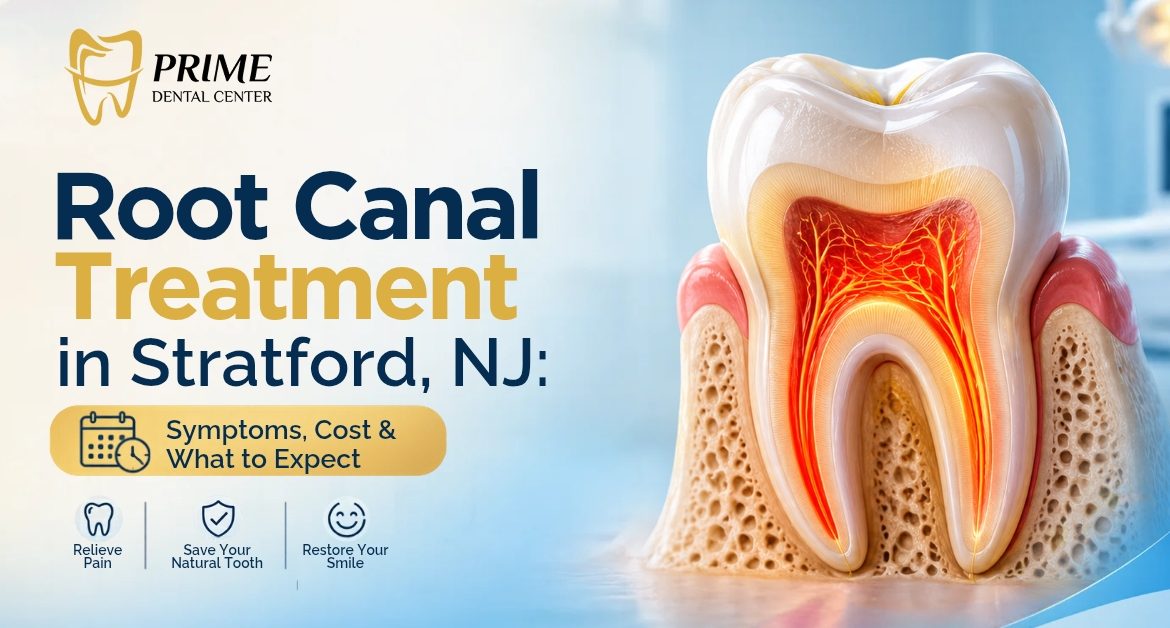
Root canal treatment removes infected or inflamed pulp from inside a tooth, cleans the canal, and seals it to relieve pain and save the natural tooth. At Prime Dental Centers in Stratford, NJ, Dr. Akshay Rajpal performs root canal treatments in a single office visit, typically completed within 60 to 90 minutes depending on the tooth’s location and complexity.
A toothache that won’t quit, sensitivity that lingers long after your coffee has gone cold, or a swollen gum that keeps you up at night — these are the kinds of symptoms that send people searching for answers at 2 a.m. If you’re experiencing any of these, there’s a good chance you’re dealing with an infected tooth that needs a root canal.
The phrase “root canal” has a reputation problem. Decades of jokes and old wives’ tales have convinced many patients that this procedure is something to dread. In reality, modern root canal treatment is comparable to getting a routine filling, and it’s one of the most effective ways to relieve dental pain and keep your natural tooth in place.
This guide covers everything you need to know about root canal treatment in Stratford, NJ: the warning signs, what causes the need for treatment, how the procedure actually works, what it costs, and what recovery looks like. Dr. Akshay Rajpal at Prime Dental Centers specializes in root canal therapy and has helped countless patients throughout Stratford and the surrounding South Jersey community get out of pain and back to normal life.
What Is Root Canal Treatment?
Root canal treatment, also known as endodontic therapy, is a procedure used to treat infection or damage inside a tooth. It involves removing the affected pulp, which contains nerves, blood vessels, and connective tissue, and then cleaning and sealing the inside of the tooth to help preserve its natural structure.
When this tissue becomes infected or inflamed — usually due to deep decay, a crack, or trauma — it can cause significant pain and, if left untreated, lead to a dental abscess.
During the procedure, your dentist carefully removes the infected or damaged pulp, cleans and disinfects the root canals, and fills them with a biocompatible material to prevent reinfection. The tooth is then sealed and, when necessary, restored with a dental crown to strengthen it and protect it from further damage.
Root canal treatment is a widely used dental procedure that can successfully preserve natural teeth and restore their function when followed by proper care and restoration. Teeth that receive a root canal and are properly restored can last a lifetime with routine care.
How Can You Tell If You Might Need a Root Canal?
Tooth pain doesn’t always mean you need a root canal, but certain symptoms are strong indicators that the pulp inside your tooth is infected or dying. Watch for:
- Persistent, throbbing tooth pain that doesn’t go away on its own, especially pain that worsens when you bite down or apply pressure.
- Sensitivity to hot or cold that lingers for several seconds or minutes after the stimulus is removed, rather than fading quickly.
- Swelling in the gums near the affected tooth, which can indicate infection has spread beyond the tooth itself.
- A darkening or discoloration of the tooth, often a sign that the internal pulp tissue has died.
- A small, pimple-like bump on the gums (sometimes called a fistula), which may drain pus and release a foul taste.
- Tenderness or swelling in nearby lymph nodes or the surrounding jaw.
Some patients experience sudden, severe pain, while others notice symptoms that come and go over weeks or months. Either way, the underlying infection typically continues to progress even if the pain temporarily subsides. Choose an evaluation sooner rather than later if you notice lingering sensitivity or swelling — untreated infections rarely resolve on their own and often worsen over time.
How Can You Tell If Your Toothache Needs Root Canal Treatment?
The only way to know for certain whether your tooth pain requires a root canal is through a clinical exam and dental X-ray. During an evaluation at Prime Dental Centers, Dr. Akshay Rajpal will assess the tooth’s sensitivity to temperature and pressure, check for visible decay or cracks, and review X-ray imaging to determine whether the infection has reached the pulp or spread to the surrounding bone.
Not every toothache points to a root canal. Sometimes pain stems from a cavity that hasn’t reached the pulp, gum disease, or even sinus pressure referring pain to the upper teeth. An accurate diagnosis matters because treating the wrong issue won’t resolve the pain and can allow a developing infection to worsen.
What Causes a Tooth to Need a Root Canal?
Several dental problems can affect the pulp inside a tooth, causing damage or infection that may require root canal treatment:
- Deep tooth decay. When a cavity is left untreated, bacteria can work their way through the enamel and dentin until they reach the pulp chamber, causing infection.
- Cracked or fractured teeth. A crack — even a small one — can expose the pulp to bacteria, whether from an injury, grinding, or biting down on something hard.
- Repeated dental procedures. Teeth that have undergone multiple fillings or treatments over the years can become more vulnerable to pulp damage.
- Trauma to the tooth. A sports injury, fall, or other impact can damage the pulp even if the tooth doesn’t visibly crack.
- Advanced gum disease. In some cases, periodontal infection can spread to the pulp through the tooth’s root.
Because many of these causes develop gradually, routine dental checkups play a key role in catching decay or cracks before they progress to the point of needing a root canal.
How Does Root Canal Treatment Work?
Root canal treatment at Prime Dental Centers follows a structured process designed to eliminate infection while keeping the patient comfortable throughout:
- Examination and X-ray. Dr. Akshay Rajpal evaluates the tooth and takes an X-ray to assess the extent of the infection and the shape of the root canals.
- Local anesthesia. The area around the affected tooth is numbed thoroughly, so patients feel pressure rather than pain during the procedure.
- Access and pulp removal. A small opening is made in the top of the tooth to access the pulp chamber. The infected or damaged pulp tissue is carefully removed.
- Cleaning and shaping. The inside of the root canals is cleaned, disinfected, and shaped to prepare for filling.
- Filling and sealing. The cleaned canals are filled with a biocompatible material (typically gutta-percha) and sealed to prevent future infection.
- Restoration. In most cases, a crown or filling is placed over the tooth to restore its strength and function, since root canal-treated teeth can become more brittle over time.
Many patients are surprised to learn that the procedure itself feels similar to getting a deep filling. The anesthesia numbs the area completely, and any discomfort experienced afterward is typically mild and manageable with over-the-counter pain relief.
How Long Does a Root Canal Take?
A typical root canal treatment takes between 60 and 90 minutes, though this varies based on which tooth is being treated. Front teeth generally have a single root canal and can be completed more quickly, while molars have multiple canals and may take longer or occasionally require a second visit.
Dr. Akshay Rajpal performs most root canal procedures in a single appointment at the Stratford office, minimizing the number of visits patients need to resolve their pain and restore the tooth.
How Much Does Root Canal Treatment Cost in Stratford, NJ?
Root canal costs vary depending on which tooth is affected, the complexity of the canal structure, and whether a crown or additional restoration is needed afterward. Molars, with their multiple canals, typically cost more to treat than front teeth with a single canal.
For an accurate cost estimate specific to your situation, the most reliable step is scheduling an evaluation with Dr. Akshay Rajpal at Prime Dental Centers in Stratford. During your visit, our team can review your X-rays, discuss your treatment needs, and walk you through the exact cost before any work begins.
Patients without dental insurance don’t need to let cost concerns delay necessary treatment. Prime Dental Centers offers the Prime Dental Membership Plan, an in-house savings program for patients who don’t have traditional dental insurance. For a flat annual fee, members receive included preventive care along with discounted rates on additional treatments — with no waiting periods, deductibles, or annual maximums. Choose the membership plan if you want predictable, discounted access to dental care without navigating insurance networks.
Does Dental Insurance Cover Root Canal Treatment?
Most dental insurance plans cover a portion of root canal treatment, typically classifying it as a major procedure. Coverage amounts and annual maximums vary significantly between plans, so it’s worth checking directly with your insurance provider about your specific benefits. Patients without insurance, or whose plans don’t fully cover endodontic treatment, can ask our Stratford office about the Prime Dental Membership Plan to help manage costs.
What Should You Expect After a Root Canal?
Recovery from a root canal is generally straightforward. Most patients experience mild soreness or sensitivity in the treated area for a few days, which can typically be managed with over-the-counter pain relievers like ibuprofen.
Here’s what to expect during recovery:
- The first 24 to 48 hours. Some tenderness around the tooth and jaw is normal, especially when chewing. Stick to softer foods during this period and avoid biting directly on the treated tooth.
- Follow-up restoration. If a permanent crown wasn’t placed during your initial visit, you’ll need a follow-up appointment to complete the restoration and protect the tooth long-term.
- Return to normal activity. Most patients resume their usual eating and oral hygiene routine within a few days.
- When to call your dentist. Contact Prime Dental Centers if you experience severe pain, swelling that worsens after a few days, or a return of the symptoms that brought you in originally — these can indicate the infection hasn’t fully resolved.
With proper restoration and routine dental checkups, a root canal-treated tooth can function normally for decades.
Root Canal vs. Tooth Extraction: What’s the Difference?
When a tooth is severely infected or damaged, patients are often faced with a choice between root canal treatment and extraction. Both resolve the infection, but they lead to very different long-term outcomes.
Root canal treatment preserves your natural tooth. Because nothing matches the function and feel of a natural tooth, most dentists recommend saving it whenever possible. A root canal also avoids the need for tooth replacement options like a bridge or implant, which tend to be more expensive and time-intensive than restoring the existing tooth.
Tooth extraction, on the other hand, removes the tooth entirely. This may be necessary when a tooth is too severely damaged, cracked below the gumline, or has insufficient bone support to restore. After extraction, patients typically need to consider a replacement option — such as a dental implant, bridge, or partial denture — to prevent shifting of the surrounding teeth and maintain proper chewing function.
Choose root canal treatment if the tooth’s structure is still sound and the infection can be fully addressed — this preserves your natural bite and avoids the added cost and time of tooth replacement. Choose extraction if the tooth is too compromised to save, such as with extensive decay below the gumline or a vertical root fracture. Dr. Akshay Rajpal can help determine which option best preserves your long-term oral health during a consultation at Prime Dental Centers.
Why Choose Prime Dental Centers for Root Canal Treatment in Stratford, NJ?
Prime Dental Centers is a family-owned dental practice with locations in Stratford and Marlton, NJ, led by Dr. Akshay Rajpal and Dr. Snehal Rajpal. Dr. Akshay Rajpal specializes in root canal procedures, bringing focused expertise to a treatment that many patients approach with anxiety.
At the Stratford office, located at 212 N White Horse Pike, patients can expect:
- Specialized expertise. Dr. Akshay Rajpal has significant experience performing root canal treatments, helping patients get precise, efficient care.
- A comfortable, patient-first approach. The team at Prime Dental Centers takes time to explain each step of treatment, helping ease the anxiety that often surrounds root canals.
- Same-day evaluations for dental pain. Patients experiencing severe tooth pain can often be seen quickly to begin the diagnostic process.
- Flexible payment options. Patients without insurance can ask about the Prime Dental Membership Plan, which offers a predictable, flat-fee way to manage the cost of preventive and restorative care.
- A family-owned, community-rooted practice. Prime Dental Centers has built its reputation in Stratford and Marlton on personalized care, not high patient turnover.
If you’re experiencing tooth pain, sensitivity, or swelling, don’t wait for the problem to get worse. Contact Prime Dental Centers’ Stratford office to schedule an evaluation with Dr. Akshay Rajpal and find out whether a root canal is the right path to relieve your pain and save your tooth.
Frequently Asked Questions
What are the most common signs that you need a root canal?
The most common signs include persistent or throbbing tooth pain, lingering sensitivity to hot or cold, swelling in the gums near the tooth, a darkened tooth, and a small bump on the gums that may drain pus. Pain that worsens when biting down is also a frequent indicator.
How do I know if my tooth pain requires a root canal?
Only a clinical exam and dental X-ray can confirm whether your tooth pain requires a root canal. Dr. Akshay Rajpal evaluates the tooth’s sensitivity, checks for decay or cracks, and reviews imaging to determine whether the infection has reached the pulp.
Is root canal treatment painful?
Root canal treatment itself is performed under local anesthesia, so patients typically feel pressure rather than pain during the procedure. Mild soreness for a few days afterward is normal and is usually manageable with over-the-counter pain relievers.
How long does a root canal take?
Most root canal procedures take between 60 and 90 minutes and are completed in a single visit at Prime Dental Centers. Molars with multiple canals may take longer than front teeth with a single canal.
How much does a root canal cost in Stratford, NJ?
Root canal costs depend on which tooth is treated and whether a crown or additional restoration is needed afterward. Scheduling an evaluation at Prime Dental Centers’ Stratford office is the most reliable way to get an accurate cost estimate for your specific situation.
Does dental insurance cover root canal treatment?
Most dental insurance plans cover a portion of root canal treatment, though coverage varies by provider and plan. Patients without insurance can ask about the Prime Dental Membership Plan, which includes preventive care and discounted treatment rates for a flat annual fee.