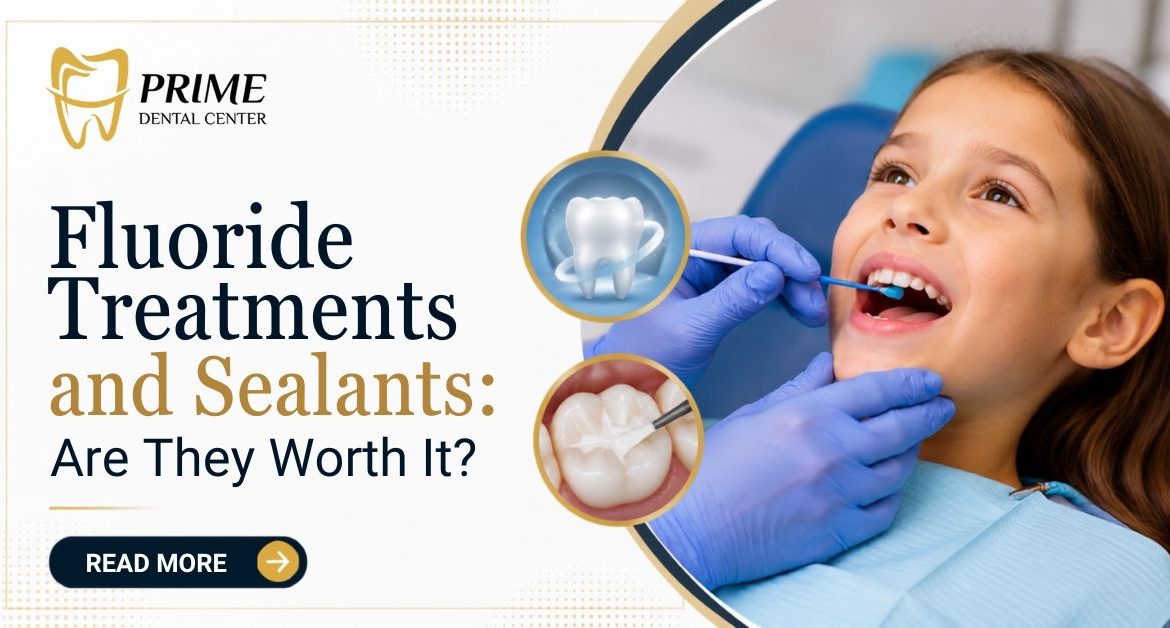
Fluoride treatments and dental sealants are two of the most effective—and most underutilized—preventive tools in dentistry. Fluoride strengthens enamel and can reduce cavity risk by approximately 25%, while dental sealants reduce cavities in permanent back teeth by up to 80% in the first two years after placement. Both are quick, painless, and available at Prime Dental Centers in Stratford and Marlton, NJ.
Most people know they’re supposed to brush twice a day, floss, and see their dentist every six months. But when the hygienist asks if you’d like a fluoride treatment, or your child’s dentist recommends sealants, it’s easy to wonder: do these things actually make a difference?
The short answer is yes—more than most people realize. The longer answer involves a little bit of dental science, some surprisingly compelling numbers, and a clear picture of who benefits most from each treatment.
This post breaks down exactly what fluoride treatments and dental sealants do, the evidence behind them, who they’re recommended for, and whether they’re worth adding to your or your child’s preventive care routine. By the end, you’ll have everything you need to make an informed decision at your next appointment.
What Is Fluoride, and How Does It Protect Your Teeth?
Fluoride is a naturally occurring mineral found in soil, water, and a variety of foods. It helps strengthen tooth enamel, making teeth more resistant to decay and supporting long-term oral health. Its relationship with teeth comes down to a process happening in your mouth every single day.
Your enamel—the hard outer layer of your tooth—is constantly losing and gaining minerals. Acids produced by bacteria, plaque, and sugars attack the enamel in a process called demineralization. In response, minerals like fluoride, calcium, and phosphate are redeposited into the enamel through remineralization. Tooth decay happens when demineralization consistently outpaces remineralization.
Fluoride tips the balance back toward protection. According to Cleveland Clinic, fluoride strengthens enamel by making it more resistant to acid attacks, slows down the demineralization process, prevents the growth of cavity-causing bacteria, and can even reverse early-stage tooth decay before a cavity fully forms.
That last point is worth pausing on. A professionally applied fluoride treatment doesn’t just prevent future damage—it can actually undo early damage that’s already occurring.
What Happens During a Professional Fluoride Treatment?
The process is straightforward and takes less than five minutes. During a routine dental visit, a dentist or hygienist applies a fluoride gel, foam, or varnish directly to the teeth. That’s it. No drilling, no needles, no downtime.
The key difference between a professional treatment and the fluoride in your toothpaste is concentration. Over-the-counter fluoride products contain a lower-strength fluoride, which provides daily maintenance. Professional treatments deliver a higher concentration that provides a more intensive boost to enamel strength—something that at-home products simply can’t replicate.
The American Dental Association (ADA) recommends fluoride varnish for patients of all ages, including adults. Most patients benefit from treatments every six months, timed to coincide with their regular cleanings. If you’re at higher risk for cavities, more frequent applications may be recommended.
Who benefits most from professional fluoride treatments?
Children benefit significantly, particularly during the cavity-prone years between ages 6 and 14. But adults aren’t off the hook. According to Cleveland Clinic, adults with any of the following conditions may benefit especially from regular fluoride treatments:
- Dry mouth — Saliva naturally neutralizes acids and washes away bacteria. Dry mouth, caused by conditions like Sjögren’s syndrome or by certain medications, removes that protection.
- Gum disease — Receding gums expose parts of the tooth not protected by enamel, increasing cavity risk significantly.
- A history of cavities — Past decay is one of the strongest predictors of future decay.
- Dental devices — Crowns, bridges, braces, and partial dentures create new areas where bacteria can accumulate.
If any of those apply to you, fluoride treatment at your next cleaning is more than just an add-on—it’s a targeted intervention.
What Are Dental Sealants, and How Do They Work?
Dental sealants take a different approach to cavity prevention. Rather than strengthening enamel from within, sealants create a physical barrier on the outside.
The back molars—the ones used for grinding and chewing—have deep pits and grooves on their surfaces. These grooves are excellent for processing food, but they’re also excellent at trapping food particles and bacteria. Brushing can clean the smooth surfaces of teeth well, but bristles often can’t reach into those narrow crevices. That’s where cavities tend to form. According to the CDC, 9 in 10 cavities in children occur on the back teeth.
A dental sealant is a thin, tooth-colored coating painted directly onto the chewing surfaces of the back molars. Once applied, the dentist uses a curing light to harden the material, essentially sealing off those grooves so bacteria can’t reach them.
The application is quick, completely painless, and requires no anesthesia. Once placed, you can eat and drink normally right away.
How Effective Are Dental Sealants? What Does the Evidence Show?
This is where sealants really earn their place in preventive care. The numbers are hard to argue with.
According to the Centers for Disease Control and Prevention (CDC), dental sealants reduce cavities in permanent molars by 80% within the first two years of placement, and continue to help protect against up to 50% of cavities for as long as four years. . A study published in PubMed Central found that 78.8% of sealant-treated teeth remained completely unaffected by dental decay.
The economic case is just as strong. The CDC reports that school-based sealant programs become cost-saving after just two years and save more than $11 for every tooth sealed over a four-year period. For families and dental practices, the math is clear: a sealant placed today costs far less than a filling—or a crown—down the road.
Children aged 6 to 11 who don’t have dental sealants are three times more likely to develop cavities than those who do, according to Cleveland Clinic. Despite this, approximately 42% of children aged 6 to 11 and 48% of adolescents aged 12 to 19 currently have sealants—meaning a large portion of children are missing out on protection that’s available, affordable, and proven.
Are Dental Sealants Just for Kids?
It’s a common assumption, but it’s not accurate. Adults without existing decay or dental fillings in their back teeth can benefit from sealants too.
The determining factor isn’t age—it’s the condition of the tooth. If your molars have never had fillings, are free of decay, and have deep grooves that put you at risk, you’re a candidate for sealants regardless of how old you are. Your dentist or hygienist can assess your teeth during a routine visit and let you know whether sealants would be a worthwhile addition to your preventive care.
One important note: sealants cannot be placed on teeth that already have existing fillings or active decay. They’re a preventive measure, not a restorative one.
How Long Do Dental Sealants Last?
Sealants typically last between four and eight years. Over time, they can chip or wear down from normal chewing, which is why your dentist will check them at each routine visit. If a sealant has worn away in certain areas, it can be touched up or reapplied. No special care is required in the meantime—regular brushing and flossing are all you need.
Fluoride Treatments vs. Dental Sealants: Do You Need Both?
These two treatments work differently and serve different purposes, which means they complement rather than replace each other.
Fluoride treatments work systemically to strengthen enamel across all teeth surfaces, making them more resistant to acid damage overall. Dental sealants provide targeted, physical protection on the specific surfaces of back teeth where cavities are most likely to form.
For most children—and many adults—using both offers the most comprehensive layer of defense. That said, individual needs vary. At Prime Dental Centers, Dr. Akshay Rajpal and Dr. Snehal Rajpal assess each patient individually and recommend preventive treatments based on their unique risk factors, dental history, and oral health goals.
Why Preventive Care Pays Off in the Long Run
It’s easy to skip a fluoride treatment or put off sealants when nothing is visibly wrong. But oral disease has real consequences beyond the mouth.
The CDC reports that 34 million school hours are lost in the United States every year due to unplanned dental emergencies. Nearly 1 in 5 adults aged 20 to 64 have untreated cavities—and almost half of adults over 30 show signs of gum disease. Untreated, these conditions can escalate into tooth loss, infections, and procedures that are far more involved than a simple sealant or five-minute fluoride application.
One year of community water fluoridation is estimated to save $6.5 billion in treatment costs nationwide. At the individual level, the same logic applies: a small investment in prevention today saves significantly more tomorrow.
Preventive Dentistry at Prime Dental Centers in Stratford & Marlton, NJ
At Prime Dental Centers, preventive care isn’t an afterthought—it’s the foundation of everything Dr. Akshay Rajpal and Dr. Snehal Rajpal do. Both trained at New York University (Dr. Akshay graduating in 2009, Dr. Snehal in 2010), and together they’ve built a family-owned practice that has served more than 30,000 patients across their Stratford and Marlton locations.
Fluoride treatments and dental sealants are offered as part of routine preventive care at both locations, alongside professional cleanings, check-ups, and personalized oral hygiene education. Whether you’re bringing your child in for their first sealants or asking about fluoride options for yourself, the team will walk you through what’s appropriate for your specific situation—clearly, honestly, and without pressure.
Take the First Step Toward a Healthier Smile
Preventive treatments like fluoride and sealants are among the most effective, most affordable tools available to protect your oral health—for you and your family. They require minimal time, cause no discomfort, and deliver measurable results backed by decades of research.
The best time to ask about them is at your next cleaning. If you’re due for a visit—or overdue—Prime Dental Centers is ready to help. Call (856) 784-1540 or book your appointment online at primedentalcenters.com to schedule your next preventive care visit at either our Stratford or Marlton, NJ location.
Frequently Asked Questions About Fluoride Treatments and Dental Sealants
Are fluoride treatments safe for children and adults?
Yes. Fluoride is safe and effective when used at recommended levels—a position supported by the ADA, the CDC, and the American Academy of Pediatrics. Professional fluoride treatments use carefully controlled concentrations applied by trained dental professionals. The amount used during an in-office treatment is well within safe limits for both children and adults.
How often should my child get fluoride treatments?
Most children benefit from a fluoride treatment at every routine dental visit, typically every six months. Children at higher risk for cavities may benefit from more frequent applications. Your dentist will recommend a schedule based on your child’s individual needs.
At what age should kids get dental sealants?
The ideal time is as soon as the permanent molars come in—usually between ages 6 and 7 for the first set, and between 11 and 13 for the second set. Getting sealants placed early maximizes their protective benefit through the most cavity-prone years. In some cases, sealants may also be appropriate for baby teeth with unusually deep grooves.
Can adults get dental sealants even if they’ve never had them before?
Yes. Adults who have cavity-free back molars without existing fillings or crowns are good candidates for sealants. It’s never too late to add a layer of protection, particularly if you have deep grooves or a history of cavities. Ask your dentist whether your back teeth are suitable for sealants at your next visit.
Does insurance cover fluoride treatments and dental sealants?
Many dental insurance plans cover fluoride treatments and sealants for children, and some cover them for adults as well. Coverage varies by plan, so it’s worth checking with your insurance provider before your appointment. Prime Dental Centers can help clarify what your plan covers—call (856) 784-1540 for assistance.
Is there any downtime after fluoride treatments or sealant placement?
None at all. Both procedures are quick and completely non-invasive. You can eat, drink, and go about your normal day immediately after. Your dentist may suggest avoiding very hot or cold drinks for a short time after fluoride varnish application, but otherwise there are no restrictions.
How do I know if I need a fluoride treatment or sealants?
The best way to find out is to ask your dentist or hygienist during your next routine visit. They’ll assess your teeth, review your dental history, and let you know whether either treatment is appropriate for your situation. At Prime Dental Centers, preventive recommendations are always personalized—never one-size-fits-all.